Biochem-307 Biochemical Analysis
(list of practical)
Preparation of different solutions (molar, normal and percentage); Preparation of buffers of different molarity and pH; (S1e4: 2.1, 2.4, 2.7-2.9, 2.11, 2.12, 2.23, 2.25)
2. Qualitative analysis of carbohydrates: Group identification test; Identification of mono, di and polysaccharides; Identification of reducing sugars; Identification keto/aldo sugars and their confirmation by phenylhydrazine test; (S1e4: 3.1-3.8)
3. Estimation of glucose in blood sample by phenol sulfuric acid method; (S1e4: 3.9, 3.12)
4. Qualitative tests for the identification of protein and different amino acids; (S1e4: 4.4)
5. Precipitation tests of proteins: casein precipitation test, acid and heat precipitation, ammonium sulfate precipitation tests etc.; (S1e4: 5.6)
6. Identification tests of lipids, group test, solubility, emulsification test, iodine absorption test, acid value and saponification number, glycerol and cholesterol qualitative tests etc.; (S1e4: 6.1-6.7, 6.11-6.13)
7. Qualitative test for nucleic acids detection; (S2e3: 1.11)
8. Estimation of vitamins (vitamin A and C), (S1e4: 7.9, 7.10)
9. Visit to related industry or lab.
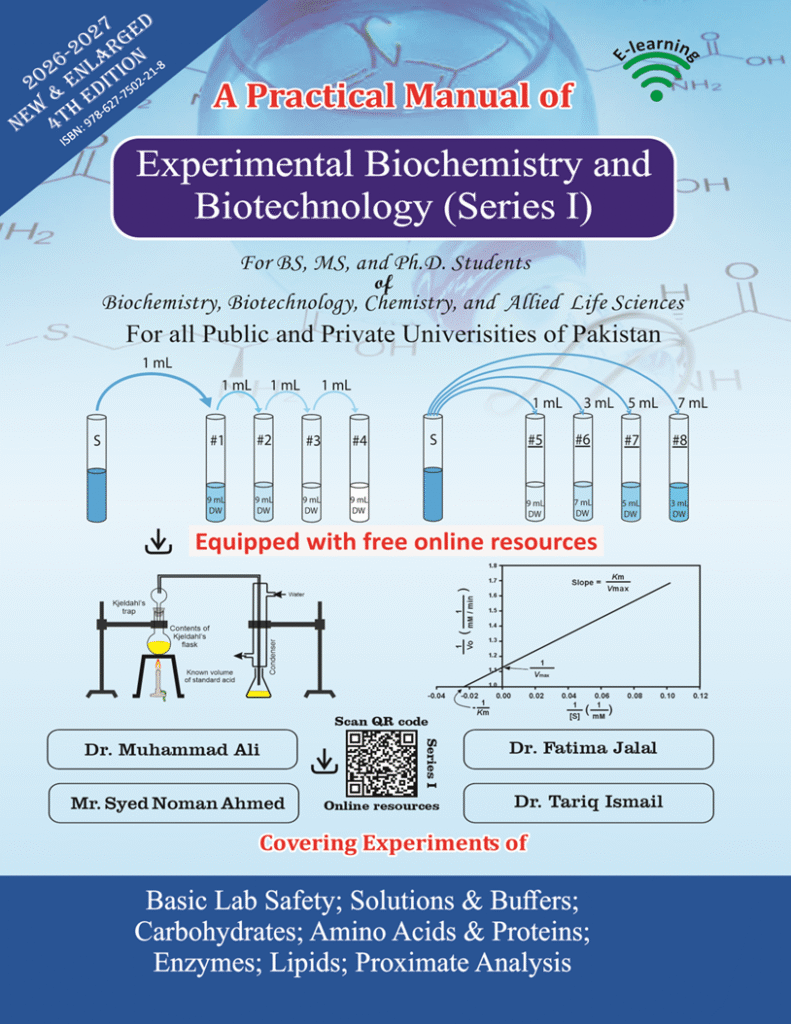
Ali, M. et al., Experimental Biochemistry and Biotechnology (Series I), 2023, 3rd edition, ISBN: 978-969-7502-04-1
Mid-term syllabus of Biochem-307:Solution, colloidal and suspension system. pH & its importance and application, Buffers: natural and synthetic buffers, characteristics of buffer, importance and applications. Henderson-Hasselbalch equation.;
…. PLUS…. First 150 MCQs from chapter 2 (150/302) the book ” MCQs in Biochemistry”. MCQs from the taught concepts and book chapters will also appear in the exam.
Final exam syllabus of Biochem-307: Reaction and mechanism of different biochemical analysis (carbohydrates, proteins, lipids and nucleic acids) and their importance. Proximate analysis, importance and applications. plus 25% of mid-term syllabus
…. PLUS…. First 150 MCQs from each of chapters 2 (150/302) and chapter -3 (150/729) of the book ” MCQs in Biochemistry”. MCQs from the taught concepts and book chapters will also appear in the exam..
……PLUS……… Final exam will contain 30% from mid syllabus.
NO EXCUSE WILL BE ACCEPTED
__________________________________________________________________________________
Meeting ID: 316 824 288 013
Passcode: WNyjeA
Microsoft teams will be used whenever online classes will be held. You must make your first name as your registration number.
2017-ag-9382 Haidar Iftikhar
2017-ag-10077 Ahmad Faraz
__________________________________________________________________________________
Link to download the book ( MCQs in Biochemistry) is given below:
https://b-ok.cc/dl/1055171/2292c5
BIOCHEM-307 BIOCHEMICAL ANALYSIS 3(1 -2)
Course Learning Outcomes
Course Learning
Outcomes
By
the end of this course students will be able to;
1.
Apply an understanding of the
methods and techniques associated to solutions, pH and buffers.
2.
Explain the principles behind
major biochemical molecules analysis.
3.
Demonstrate food and feed
analysis.
4.
Estimate different vitamins.
Theory
Solutions,
colloidal and suspension systems; pH, its importance and applications; Buffers:
natural and synthetic buffers; Characteristics of buffer; Importance and
applications; Henderson-Hasselbalch equation; Major biomolecule’s analysis
(carbohydrates, proteins, lipids and nucleic acids): Reactions, their
mechanisms and importance; Proximate analysis: Analysis of food/feed samples,
its importance and applications.
Practical
Preparation of
different solutions (molar, normal and percentage); Preparation of buffers of
different molarity and pH; Qualitative analysis of carbohydrates: Group
identification test; Identification of mono, di and polysaccharides;
Identification of reducing sugars; Identification keto/aldo sugars and their
confirmation by phenylhydrazine test; Estimation of glucose in blood sample by
phenol sulfuric acid method; Qualitative tests for the identification of
protein and different amino acids; Precipitation tests of proteins: casein
precipitation test, acid and heat precipitation, ammonium sulfate precipitation
tests etc.; Identification tests of lipids:
group test, solubility, emulsification test, iodine absorption test, acid value and saponification number, glycerol and
cholesterol qualitative tests etc.; Qualitative test for nucleic acids
detection; Estimation of vitamins (vitamin A and C), Visit to related industry
or lab.
Suggested Readings
1. Boyer, R.F. 2014. Modern Experimental Biochemistry.
3rd Ed. The Benjamin/Cummings Publishing Co., USA.
2. Rodwell, V.W.,
D. A. Bender, K.M. Botham, P.J. Kennelly, V. Rodwell and P.A. Weil.
2018. Harper’s Illustrated
Biochemistry, 31st Ed. The McGraw-Hill Education, USA.
3. Sawhney, S.K. and R. Singh. 2014. Introductory
Practical Biochemistry. Narosa Publishing House, 5th Ed. New Delhi,
India.
4. Shawn, O.F.
and L. E. Taylor. 2009. Biochemistry Lab Manual. Cengage Learning, USA.
5. Woods, A.E., M.R. Wells and L.W. Aurand. 2013. Food Composition and Analysis.
Dordrecht, Springer Netherlands.
7. Ali, M. et al., Experimental Biochemistry and Biotechnology (Series I), 2019, 3rd edition, ISBN: 978-969-7502-04-1
8. Ali, M. et al., Experimental Biochemistry and Biotechnology (Series II), 2019. 1st edition, ISBN: 978-969-23317-2-2.
9. Ali, M. et al., Experimental Biochemistry and Biotechnology (Series III), 2023, 1st edition, ISBN: 978-969-23317-6-0
| Articles for presentations: https://drive.google.com/drive/folders/1elpSAZaYhPgCEt1aSXOUZTcVijkAyvPx?usp=sharingAli |
|